
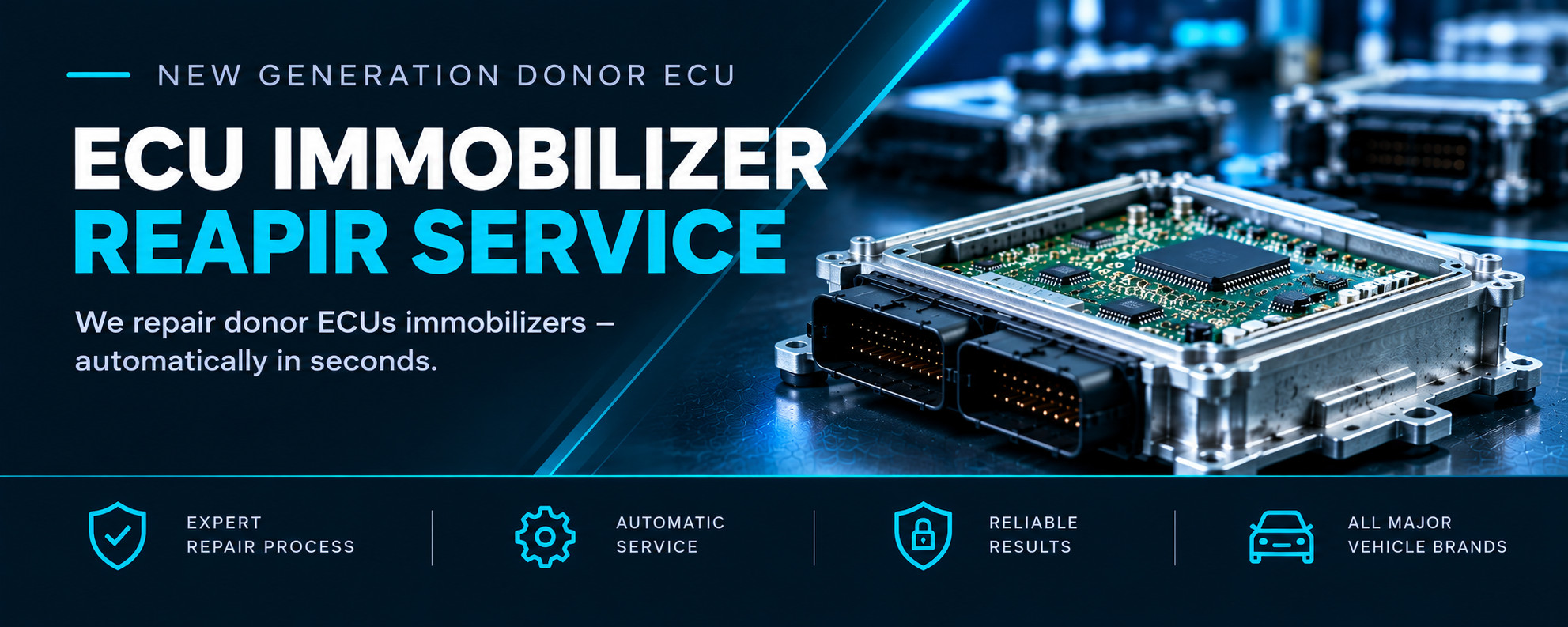
Read immobiliser data, clone a donor ECU or change the immobilizer state — from an EEPROM + Processor dump.
Our VAG EDC17 / MED17 Immobilizer Tool is easy to use. Simply upload the EEPROM dump and processor dump, and the tool will read and modify the immobilizer data directly.
Includes:
Need more? Additional files are available at 50% of the Credit Plan rate.
Pay only when you need a file:
1 credit = €10 + TAX. Credits are sold in packages of at least 10 credits and not individually.
To start using the Database and AutoTune system:
Start today and see how effortless tuning can be when technology takes care of the time consuming work.
Technical Guidelines and Troubleshooting
Before attempting any engine control unit (ECU) replacement, cloning, or immobilizer related operation, verify hardware and software compatibility, understand the vehicle's starting authorization system, and establish the ECU's service history. Incorrect procedures, incompatible files, or previously modified data can lead to starting problems, communication failures, or permanent ECU damage.
When replacing an engine control unit, confirm that the original unit and the replacement are compatible with the vehicle before programming or installation.
Some manufacturers support software conversion or reprogramming procedures that can make a compatible unit suitable for a particular vehicle. Availability depends on the ECU type, manufacturer, and approved programming methods. Do not assume compatibility based on physical appearance alone.
Before modifying or programming an ECU, determine whether any previous work has been performed on it. Ask the customer for all available information, including:
This is particularly important for newer ECU generations, which may use protected memory, unique microcontroller identifiers, security passwords, secure hardware modules, or one time programmable data. Unlike many older units, these ECUs may not support straightforward one to one cloning.
Previous modifications or unsuccessful programming attempts can compromise access to protected functions and, in some cases, make recovery extremely difficult or impossible. Establish the ECU's history before starting work; altered or missing original data may limit the available repair options.
A failed start does not, by itself, confirm an immobilizer fault. Establish the circumstances under which the problem occurred and distinguish between possible causes:
Diagnostic trouble codes, module status information, and live data can help isolate the cause. Depending on the vehicle, useful checks include engine speed during cranking, fuel pressure, injector operation, fuel pump activation, power supply, and communication with relevant control modules.
Determine whether the engine does not crank, cranks but does not start, or starts briefly and then stops. These symptoms can indicate different faults and require different diagnostic procedures.
An engine that stops while driving should not automatically be attributed to the immobilizer. Investigate engine management, fuel delivery, electrical supply, sensor signals, and other relevant systems before reaching a conclusion.
Immobilizer functionality varies by manufacturer, ECU generation and vehicle security architecture. On some older or standalone engine management systems, an immobilizer modification may allow the engine ECU to operate without the original transponder authorization. This should not be assumed to apply to newer vehicles.
Many modern solutions are designed for specific ECU replacement scenarios rather than lost key situations or vehicles for which all keys are missing. An ECU level modification does not replace the need for a coded key, restore communication between security modules or correct a fault elsewhere in the vehicle's authorization system.
Confirm that any proposed repair is appropriate for the specific ECU and vehicle. An immobilizer modification is not a universal substitute for key programming, module adaptation, or repair of the original security system.
On many modern vehicles, starting authorization depends on communication between multiple components, including the key, engine ECU, instrument cluster, BCM, and other security modules where applicable. The exact arrangement varies by manufacturer and vehicle platform.
If the vehicle does not crank or displays an immobilizer warning, investigate the complete authorization chain rather than focusing exclusively on the engine ECU.
If the engine starts but comfort functions such as power windows stop working after ECU related work, check relevant module coding, configuration, communication and synchronization status.
These symptoms do not automatically indicate a fault with the immobilizer procedure. They may point to a separate issue involving the key, dashboard, BCM or another vehicle module. Diagnose the affected system and restore compatibility or synchronization using the manufacturer's supported procedures.
Programming equipment may use different file formats and provide different levels of access to ECU memory. Confirm that the read method, file type and programming procedure are appropriate for the intended work.
Where possible, maintain verified backups of original data and record the ECU identification, tool used, read method and modifications made.
Never interrupt a programming session or disconnect the power supply while an ECU is being written. Use a stable, appropriately rated power supply and follow the equipment manufacturer's instructions.
Modern ECUs may incorporate security and anti-tampering mechanisms that prevent unrestricted copying of all internal data. Depending on the platform, these may include protected memory regions, unique microcontroller identifiers, security passwords, secure hardware modules, and one time programmable areas.
A procedure that works on an older ECU may not work on a newer unit, even when the hardware appears similar. If an ECU has been incorrectly programmed, modified or subjected to an incompatible cloning procedure, it may lose access to protected functions or become difficult to recover.
In severe cases, a replacement unit with the correct hardware and supported configuration may be necessary. Failed read or write operations, unavailable service modes or rejected security access may indicate a problem with the ECU's security state or programming history. Investigate these symptoms before attempting further modifications.
Advanced ECU work should only be undertaken with suitable equipment, verified data and a clear understanding of the platform's limitations.
The engine ECU and the vehicle's starting system do not necessarily perform the same functions. Depending on the vehicle architecture, the engine ECU may control engine start authorization while another module manages key recognition, ignition authorization or starter motor activation.
Changing the immobilizer status within the engine ECU therefore does not guarantee that the starter motor will operate.
If the vehicle does not crank, investigate the starter circuit, ignition authorization, key recognition, relevant control modules and associated fault codes. Do not assume an ECU level immobilizer procedure will resolve a fault elsewhere in the starting system.
Testing of starter control circuits must follow the vehicle manufacturer's diagnostic procedures and applicable safety requirements.
An immobilizer related ECU modification does not necessarily restore the vehicle's original security system functionality. Depending on the solution and vehicle platform, diagnostic trouble codes, immobilizer warnings or blocked status messages may remain present. Interpret these indications in the context of the vehicle's configuration and the work performed.
Define the intended outcome before starting work. If the requirement is to restore the factory immobilizer system and eliminate related faults, the appropriate solution may involve repairing the original system, programming keys, adapting modules or carrying out manufacturer supported ECU replacement procedures.
Do not present a modified immobilizer configuration as a complete repair of the vehicle's security system unless the relevant functionality has been verified.
Please read this notice carefully before using any information relating to engine control units (ECUs), immobilizer systems, vehicle programming or associated diagnostic procedures.
The information provided in this guide is intended for general technical and educational purposes and is directed at qualified automotive technicians, ECU specialists and professionals with appropriate knowledge of vehicle electronics and diagnostic procedures.
All repair, programming, configuration and ECU related operations must be carried out by competent personnel using suitable equipment and in accordance with applicable manufacturer instructions, technical requirements and local laws.
The user is solely responsible for verifying vehicle compatibility, identifying the underlying fault, selecting the appropriate procedure and ensuring that all work is performed safely and lawfully.
Immobilizer systems and related electronic security components are designed to prevent unauthorized vehicle use. Any modification, bypass, deactivation or alteration of these systems must only be performed where legally permitted and with appropriate authorization from the vehicle owner or other lawful rights holder.
Unauthorized circumvention of vehicle security systems, interference with anti-theft protections or modifications intended to facilitate unlawful vehicle use are not permitted.
Users are responsible for confirming that their intended work complies with all applicable laws, regulations, insurance conditions, warranty requirements and vehicle inspection standards in their jurisdiction.
Modifications that affect factory security features may compromise the vehicle's original theft protection or affect its eligibility for road use. Where required, the original security functionality must be restored before the vehicle is returned to service.
ECU programming, cloning, software modification and related operations carry inherent risks, including data corruption, loss of communication, failure to start, malfunction of associated control modules and permanent damage to electronic components.
Incorrect hardware or software selection, incompatible files, interrupted programming, inadequate power supply or unauthorized changes to protected data may result in faults that cannot be reversed using ordinary diagnostic procedures.
Users must take appropriate precautions, including verifying compatibility, maintaining stable power during programming, preserving original data wherever possible and following the equipment manufacturer's instructions.
No procedure should be attempted unless the user understands its limitations and has the necessary technical competence, tools and recovery options.
Any vehicle subjected to ECU or immobilizer related work must be thoroughly checked before being returned to the customer or placed back into service.
Verification should include relevant starting and running functions, diagnostic fault status, communication with associated control modules and any safety critical systems potentially affected by the work.
A vehicle must not be considered fully repaired solely because the engine starts. Outstanding faults, warning indicators, altered security functions or unexpected behavior must be investigated and documented.
Vehicles with unresolved safety related faults must not be returned to road use until the applicable safety requirements have been satisfied.
Vehicle electronics, ECU security architectures, software versions and manufacturer procedures vary considerably. Results that are achievable on one ECU or vehicle configuration may not be achievable on another.
All information is provided on an "as is" and "as available" basis, without any express or implied guarantee that a particular procedure will work, produce a specific result or be suitable for every application.
No guarantee is made regarding ECU recoverability, compatibility, successful programming, restoration of factory functionality or the absence of diagnostic trouble codes following a modification.
To the maximum extent permitted by applicable law, the provider of this information accepts no liability for damage, data loss, programming failure, vehicle malfunction, loss of security functionality, repair costs, vehicle downtime or other direct or indirect losses arising from the use or misuse of the information provided.
This limitation does not exclude or restrict any liability that cannot legally be excluded or restricted, including any applicable mandatory consumer rights or statutory obligations.
Users are responsible for their own decisions, technical procedures, equipment, modifications and the consequences of their work.
By using this information, the user acknowledges that ECU and immobilizer related operations require appropriate technical expertise, careful risk assessment and compliance with all applicable legal and safety requirements.